Dark or pigmented lips: is a natural lip blush possible?
Your saved folder contains twelve lip blush photographs. Every pair of lips is pale pink, almost peach. Your own lips have deeper rosewood colour, a darker border or a distinctly pigmented upper lip. The longer you compare them, the larger the question becomes: is natural lip blush even possible for you?
In many cases, harmonious permanent lip pigmentation is possible. But “natural” does not mean turning every lip into the same pale rose. It means understanding the existing tone, calming transitions and developing a colour that belongs to the bare face. Olga Keller plans for your lips, not somebody else's before-and-after photograph.
Natural is not one particular shade of pink
Lips occur naturally in a wide range of colours: from pale rose through mauve and rosewood to rich brown, berry or violet nuances. A deeper shade is not automatically a flaw and does not have to be “corrected away”. It may be a beautiful, defining part of the face.
Image searches become misleading when only one skin type and one result are presented as the ideal. A pale peach that looks translucent over a light starting lip cannot simply be copied onto a more strongly pigmented lip. The optical mixture with the natural base would be different.
Olga therefore first asks what actually bothers you. Is it the entire deeper tone, an uneven border, a noticeably darker upper lip or simply a wish for greater colour clarity? A precise concern leads to a more refined solution than a general demand to “make everything lighter”.
The colour map begins without filters or lipstick
During consultation, Olga examines the lips in neutral light and mentally divides them into areas: upper lip, lower lip, centre, border, corners and any sections with stronger pigmentation. Not every area needs the same technique or amount of colour.
Bring bare-faced daylight photographs. Beauty filters, strong ring lights and automatic smartphone brightening often alter skin and lips differently. An honest picture from normal distance is more useful than an extreme macro that turns every natural structure into drama.
Inspiration photographs are read differently too. Olga looks beyond the exact pink to the overall effect, saturation and contrast with the face. Perhaps what you admire is not the shade itself, but the quiet outline or cared-for impression.
Neutralising is not bleaching or covering
The term “lip neutralisation” can sound as though existing pigmentation will be erased. PMU does not bleach the skin. Healed pigment supplements the starting tone and is perceived together with it. The result is an optical blend, not opaque foundation.
Warm corrective shades may have a role with certain cool or deeper bases. Applying a large amount of orange or peach as a universal formula would not be professional. Intensity, undertone, distribution and healing response must be controlled, otherwise the colour may become unsettled or excessively warm.
Some lips benefit from a staged approach: first a cautious preparatory balance, then complete healing, and only afterwards a decision about the final target shade. Olga does not promise full lightening or a freely selected catalogue colour in one session.

A realistic target is often more beautiful than copied pink
A successful result may be more even rosewood, warmer mauve, soft brown-rose or a custom berry blend. It need not become dramatically lighter to appear fresher and more harmonious. Sometimes a calmer border alone changes the whole impression.
The permanent base should remain believable without makeup. Pale trend colours, opaque nude or vivid pink can still be worn as lipstick and removed at night. What stays in the skin remains closer to your own colour world.
New, growing, changing or sharply defined dark areas are not cosmetically covered with pigment. The same applies to wounds, pain or active inflammation. Such changes need medical or dermatological assessment before PMU.
Deeper starting tones require patience during healing
Immediately after treatment, the implanted shade looks strong and often considerably warmer. Over the following days, the dry surface alters the impression before the colour softens. The natural undertone remains part of the picture and may appear stronger or quieter at different healing stages.
This is why no decision about “enough neutralisation” is made after a few days. Only after complete settling can the resulting blend be assessed. Additional pigment is placed purposefully, not out of impatience.
With existing PMU, Olga checks which colour is already in the skin before a lip pigmentation refresh. Old pigment and natural pigmentation must not be confused. Simply layering another colour over both may make the result heavier rather than more beautiful.
Olga Keller sees the lip, not the trend template
Olga Keller is a state-trained cosmetician with a medical foundation and has been one of Berlin's pioneers in microblading and permanent makeup since 2013. After thousands of successful treatments, she knows deeper lips do not need a stronger template; they need particularly precise colour analysis.
She uses certified German-made pigments that are free from heavy metals and iron oxides. Clients travel from across Germany and abroad, while public figures and politicians trust her discreet work. Her principle remains that the result should look as though nothing has been done.
If a requested pale pink cannot be achieved naturally over the starting tone or the skin is unsuitable, Olga says so and declines. Hundreds of five-star reviews value that honesty. Natural permanent makeup does not replace your own lip colour; it helps it appear calmer and more intentional.
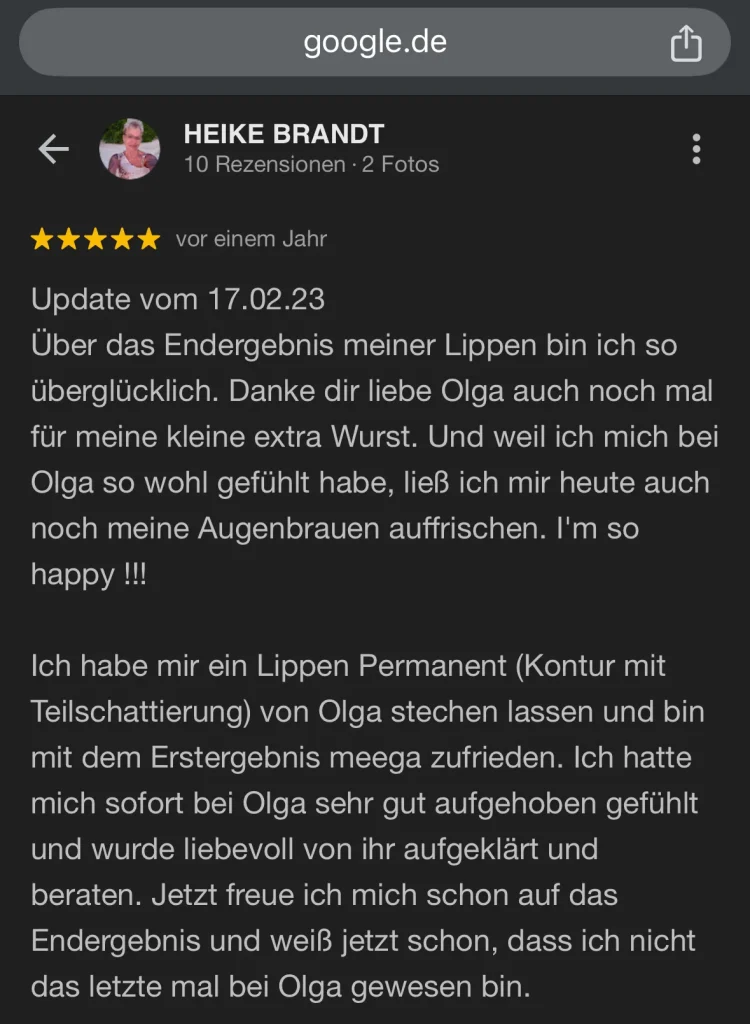

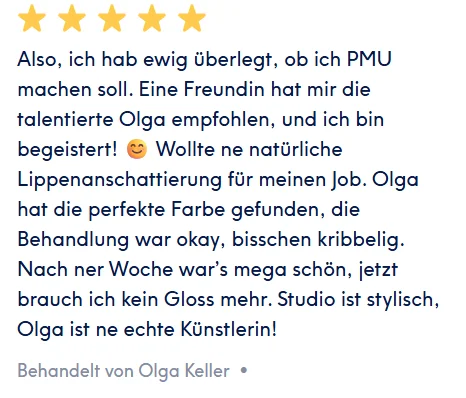

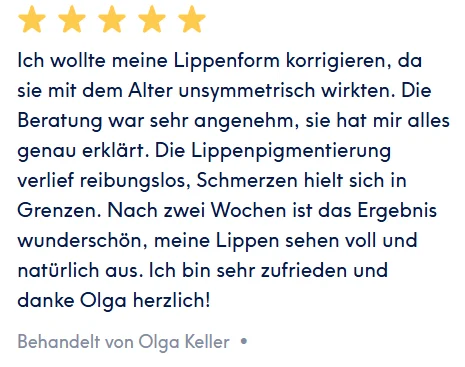




Olga Keller has many regular clients in Berlin, and numerous new clients arrive through personal recommendations. A suitable appointment may therefore require some notice. Enquire early: an individual colour strategy deserves more care than the quickest empty space in a calendar.