My lips look bluish or cool: which colour makes them fresher?
A rose-coloured jumper suddenly makes your lips appear grey. Under warm restaurant lighting, they look completely normal. At the makeup counter you reach for peach lipstick, but without cosmetics the cool impression returns. The obvious conclusion seems to be that permanent makeup simply needs plenty of warm colour.
It is not that simple. Healed pigment does not sit on the surface like lipstick; it is perceived together with your own lip tone. Professional permanent lip pigmentation therefore behaves more like light passing through coloured glass than opaque paint on white paper. Olga plans not only the desired shade but the interaction between both layers.
First distinguish a cool undertone from suddenly blue lips
Many people describe a stable lip tone that has existed for years as cool, violet or slightly bluish. Light, skin characteristics, natural pigmentation and circulation can all influence this impression. That is different from lips which suddenly turn blue or grey.
A sudden blue or grey colour, especially with breathing difficulty, chest pain, confusion or dizziness, is not a cosmetic concern and requires immediate medical help. Newly developed, sharply defined or changing dark areas should likewise be medically or dermatologically assessed rather than covered with pigment.
Olga therefore asks how long the shade has been present, whether it has changed and when it becomes noticeable. Permanent makeup is considered only once the starting situation is stable, healthy and appropriate for cosmetic treatment.
The lip is coloured glass, not a blank canvas
Imagine two translucent layers. The natural lip remains underneath while healed pigment supplements it. A warm rose placed over a cool base does not automatically become the rose seen in the pigment bottle. The visible result is an optical mixture.
This is why the same blend can heal differently on two clients. Skin response, starting colour, saturation and healing all contribute. Responsible planning does not promise an exact copy of a lipstick shade or total neutralisation after one session.
Olga examines upper and lower lips, centre, border and corners separately. Often the entire lip is not equally cool. Applying the same warm amount everywhere could create flat or uneven colour. Technique must follow the actual colour map.
Why “just put orange over it” is not a strategy
In colour theory, warm tones oppose cool ones. Online, this quickly becomes advice to neutralise bluish lips with orange. The logic may look simple on paper, but intensity, depth and healing in living skin are not comparable to a paint box.
Too much warmth may heal dominant, yellowish or disconnected from the face. Too little may barely change the cool impression. Olga therefore does not choose a loud opposing colour. She develops a controlled blend and decides whether a staged approach would be more responsible.
The most useful permanent base is often quieter than expected: a warm but muted rose, soft rosewood or a custom shade. It must look believable on a bare face in the morning. Coral, berry or red can still be worn over it as decorative colour.

A fresher colour may require more than one session
With a distinctly cool or deeper starting tone, Olga may first plan a preparatory colour balance. Once healed, she assesses how the lip has responded and which shade remains visible. Only then can the next step be chosen responsibly.
This is not delay; it is control. Forcing an opaque target shade in one step would ignore individual response. A staged plan gives the skin time and avoids adding further pigment to an intermediate result that cannot yet be judged.
The natural lip shape remains the boundary. Warmer colour creates no volume, filler effect or new border outside the red lip area. Fresher means more alive in colour, not larger or lacquered.
The first days are especially unreliable for colour
Immediately after treatment, the shade appears stronger and warmer. Temporary swelling and the fresh skin surface alter light reflection. During healing, colour may look paler, patchy or briefly cool again. No single day provides a final colour verdict.
Only once the area has fully settled does the combined result of starting tone and pigment become visible. A refinement is planned from that result, not from anxiety on day three. One section may need greater warmth, while additional saturation may be unsuitable elsewhere.
With existing PMU, Olga also examines previous pigment before a lip pigmentation refresh. A cool effect can come from natural tone, faded pigment or both. Simply adding warmth would not be a proper assessment.
Olga Keller blends for a face, not a colour chart
Olga Keller is a state-trained cosmetician with a medical foundation and has been one of Berlin's pioneers in microblading and permanent makeup since 2013. After thousands of successful treatments, she knows that a technically “warm” pigment does not automatically look fresh or natural.
She uses certified German-made pigments that are free from heavy metals and iron oxides. Clients travel from across Germany and abroad, while public figures and politicians trust her discreet approach. Her principle is that the result should look as though nothing has been done.
If the starting tone, skin condition or expectation cannot produce harmony, Olga declines. Hundreds of five-star reviews value this honesty. Natural permanent makeup does not fight coolness with maximum warmth; it finds the shade in which the whole face looks fresher.
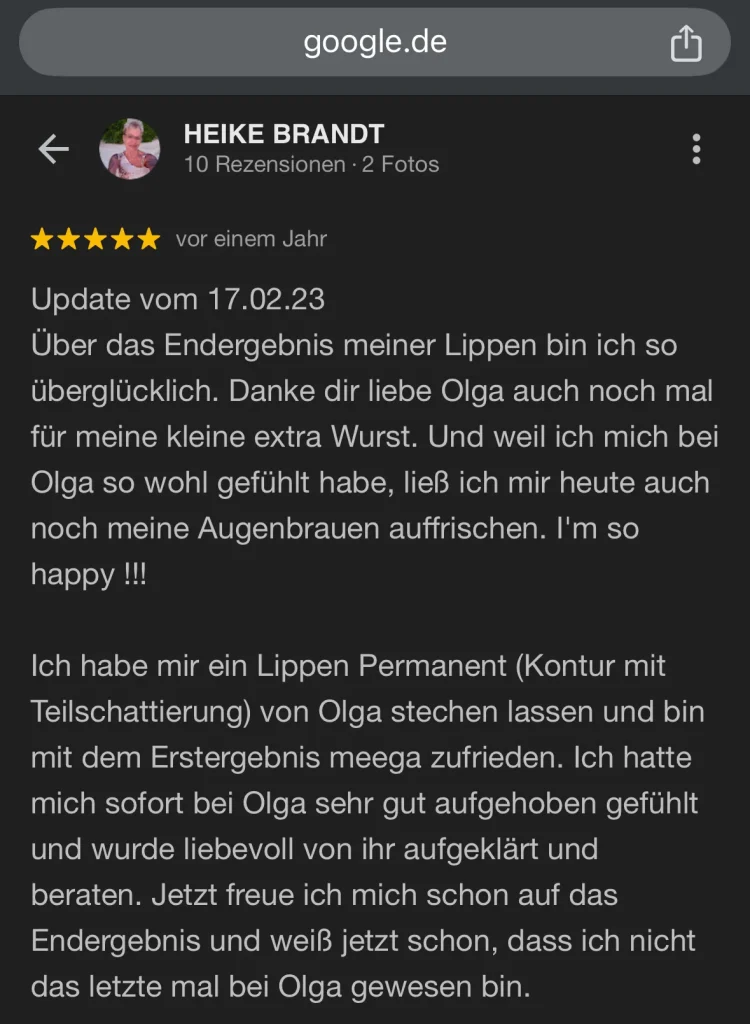
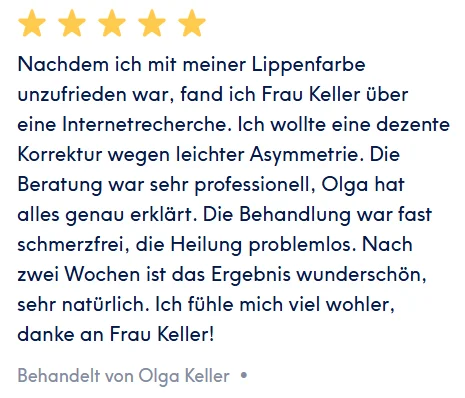
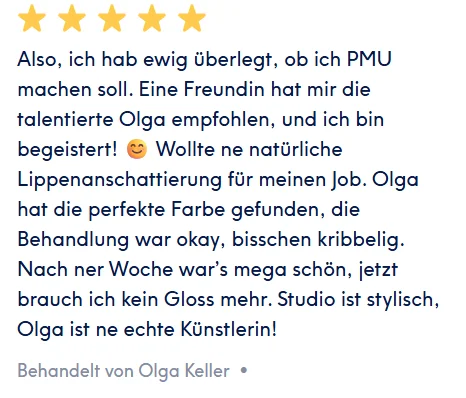

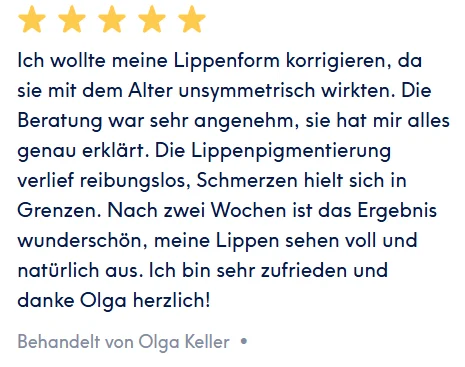




Olga Keller has many regular clients in Berlin, and numerous new clients arrive through personal recommendations. A suitable appointment may therefore require some notice. Enquire early: an individual colour blend deserves more care than the quickest empty space in a calendar.