
One eye looks smaller than the other: can eyeliner create harmony?
You barely notice it in the mirror, then a photograph makes it obvious: one eye looks more open and the other narrower. Make-up turns into a correction exercise. The line becomes thicker on the supposedly smaller side, the outer corner longer and the mascara stronger. Yet more black does not automatically make an eye look larger. It may reduce the visible space even further.
Carefully designed lash line enhancement can make the visual frame around both eyes feel calmer. Permanent makeup does not change the eyeball or the lid opening. It can work with natural differences and balance the overall expression, but cannot promise mathematically identical eyes.
“Smaller” can mean five different things
Sometimes the visible opening is genuinely a little narrower on one side. Often the impression comes from a deeper lid fold, a differently positioned brow, paler lash roots or an outer corner that turns down slightly sooner. Shadow and head position also change what we see.
A front-facing phone camera can exaggerate differences. Short distance, a wide lens and a mildly turned head make the nearer half of the face appear larger. One selfie is therefore not reliable measurement. What matters is how the eyes work together at conversational distance, in movement and under different light.
Before designing, Olga looks beyond width. She observes the lash roots, lid fold, brow line, visible skin and expression. Only then can she decide whether an optical adjustment with pigment would actually help.
Why a thicker line can weigh down the smaller eye
A broad dark contour occupies visible lid space. If it is strengthened on the side that already looks narrower, that eye may appear even more closed. The intuitive correction then works against the desired result.
A different approach is often more useful: work very finely between the roots on both sides, place the outer finish slightly differently or adjust visible length rather than thickness. Natural permanent eyeliner may look balanced without being geometrically copied.
Sometimes the most harmonious solution is to use less on the eye that appears larger rather than burdening the smaller one with extra colour. Balance does not always mean adding. It can mean deliberately leaving something out.
Symmetry is judged on the open face
Two identical lines on closed lids can look entirely different once the eyes open. Skin folds and expression move the visible sections. The preliminary design is therefore checked repeatedly with the eyes open: looking ahead, relaxed, blinking softly and viewed from normal distance.
Photographs help when they show several situations. Do not bring only the image where asymmetry looks strongest. A neutral daylight picture, a smiling photograph and your usual make-up together provide a more honest view.
If pigment is already present, a permanent eyeliner refresh needs fresh planning. An old imbalance cannot sensibly be hidden beneath increasingly broad layers. Colour, shape and skin condition must be considered together.
Sudden asymmetry does not belong at a make-up table
Small differences present for years are normal in faces. An eye that suddenly looks smaller, a newly drooping lid, one-sided swelling, double vision, pain or a change in sight need medical assessment. A PMU consultation cannot replace that.
Eyes and lids must also be healthy and calm on treatment day. Inflammation, a stye, broken skin or unexplained symptoms mean postponement. Medication, eye drops, previous surgery and known reactions are discussed beforehand; never alter a prescription on your own.
This boundary matters because optical harmony can only be planned responsibly on a medically understood foundation. A cosmetic line must not hide a new change that should first be examined.
Olga Keller does not chase two perfect halves
Olga Keller is a state-trained cosmetician with a medical foundation and has pioneered permanent makeup in Berlin since 2013. Almost 13 years of experience and thousands of treatments have refined her eye for natural asymmetry, moving lids and subtle optical balance. Clients travel from Germany and abroad, while well-known figures and politicians trust her precision and discretion.
She uses certified German-made pigments free from heavy metals and iron oxides. Her philosophy is that the result should look as though nothing was done. Olga does not try to copy one side of the face onto the other. She preserves character and reduces only the difference that makes the gaze feel unsettled.
If a requested correction cannot be achieved harmoniously with pigment or the eye area is not ready, she refuses or postpones. Hundreds of five-star reviews value that honesty. Excellent PMU does not standardise a face; it makes the whole expression feel more coherent.










A good design should not feel “corrected”
Before the consultation, note when the difference bothers you: without make-up, in photographs, while smiling or only after drawing a thick line. Those situations reveal which element alters perception. A very small change at the lash roots may be enough.
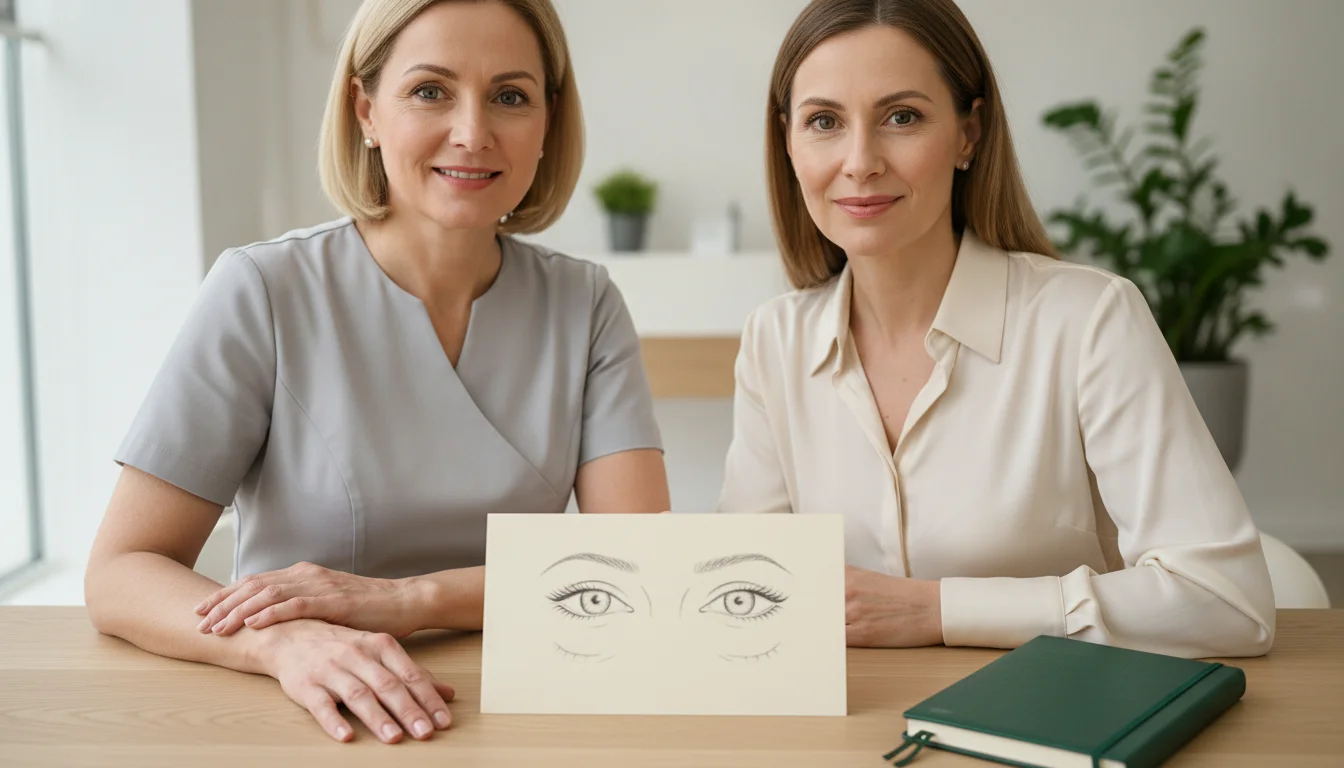
Olga sketches the possible effect and views it with you from several distances. The goal is not for every measurement to be identical. The goal is for your gaze as a whole to look calm, open and natural.
Olga personally cares for many returning clients in Berlin, and numerous new clients come through recommendations. A suitable appointment may therefore need a little notice. Enquire early: for such subtle optical balance, thoughtful planning is more valuable than the first free slot.