When does a permanent makeup refresh no longer make sense?
Imagine an unusually successful appointment. You arrive hoping for fresh colour, Olga Keller studies your skin, shape and residual pigment, and you leave without being treated. There is no before-and-after photograph and no instant visible change. Was the appointment a failure? Quite the opposite. It may have protected your face from a layer that would be difficult to reverse later.
A PMU refresh makes sense only when additional colour will improve the healed result. It is not a compulsory maintenance appointment or a reward for reaching a particular year in the calendar. Sometimes choosing not to treat is the most precise form of professional work.
A refresh must still solve the same problem
In a conventional refresh, the original idea is still right. The brow shape suits the face, the eyeliner sits well or the lip colour remains harmonious; only definition and consistency have softened. Selective additions can then preserve a strong foundation.
If your wish has changed fundamentally, a refresh answers the wrong question. You may now want bold brows to be narrower, a long eyeliner wing to be shorter or dark lips to become considerably lighter. More pigment cannot create these changes because it adds visible information instead of removing it.
Even “I simply want it to look like the day after my first treatment” needs interpretation. Fresh PMU is deliberately stronger than the healed result. The aim is not to preserve the most intense day forever, but to plan an effect that still looks natural months and years later.
Every additional layer changes future options
Skin is not a sheet of paper replaced after every drawing. Pigments fade, but their remains become part of the next decision. When generous new layers are added at every check, a delicate result can gradually turn into a compact area.
With PMU eyebrows, visible skin between strokes or beneath powder shading is especially valuable. It makes the result feel alive. A new stroke needs clear space; on a dense base, it creates extra darkness rather than new delicacy.
The same applies elsewhere. A lip outline repeatedly retraced may become harder. An eyeliner refresh repeatedly made wider will not automatically become more subtle at the next visit. A good decision therefore considers not only today's photograph, but the freedom available at the next treatment.
Three reasons for an appointment without pigment
The first is an already saturated foundation. Old strokes have broadened, shading looks closed or several corrections sit on top of one another. What is missing here is not colour but visual lightness. Adding more cannot solve that problem.
The second is a conflict between old shape or colour and the new goal. Strong grey, red, orange or dark residue cannot be covered with any desired shade. A badly positioned outline remains visible under a new one. When addition cannot create a harmonious direction, refreshing is no longer the right service.
The third is the skin itself. Irritation, inflammation, injury, incomplete healing or unexplained changes rule out pigmentation for now. Medical concerns must be assessed by a doctor. Scarred or repeatedly treated skin may also need a different strategy or a longer pause.
The real plan begins after no
“Do not refresh today” is not a dead end. It may mean allowing the residual tone to fade further and reviewing it later. Preparatory correction or specialist advice about lightening may be needed. Sometimes an adapted design becomes possible once the old foundation has softened.
With a lip PMU refresh, for example, an intense old outline can prevent the delicate watercolour effect you now want. The correct sequence is more valuable than quickly adding colour. Patience can also restore choices when brows or eyeliner currently offer limited options.
Some results have become lighter but remain beautiful. Not every softer colour is a defect. If you feel comfortable without makeup and the shape and tone still work, PMU is allowed to continue fading quietly. A good condition does not require treatment simply because treatment would technically be possible.
Three questions before you book
First ask yourself whether you want to preserve the existing idea or actually change it. Second, what specifically is missing in daily life: isolated areas, consistency or an entirely different shape? Third, would you still seek a refresh if nobody but you noticed the slight fading?
These questions do not replace professional assessment, but they make the conversation clearer. Bring makeup-free daylight photographs and, if possible, pictures of the fully healed former result. Share the known technique, approximate year and number of sessions. There is no need to guess an unknown pigment brand.
Discuss relevant conditions, medication and unusual healing experiences openly. Prescription medication must never be changed or paused independently for a PMU appointment. Good preparation is not about making treatment happen at all costs; it is about making a responsible decision possible.
Olga Keller protects the result beyond the result
Olga Keller is a state-trained cosmetician with a medical foundation and has been a microblading pioneer in Berlin since 2013. Almost 13 years of experience and thousands of successful treatments have taught her when a small addition preserves beauty and when it consumes future options. Clients travel from across Germany and abroad to see her; well-known personalities and politicians trust her precision and discretion.
Olga uses certified German-made pigments free from heavy metals and iron oxides. Her philosophy is naturalness: the result should look as though nothing has been done. If a refresh cannot achieve that goal, she does not perform it. Hundreds of five-star reviews on Google, Treatwell, Facebook and other platforms show how much clients value this honesty.

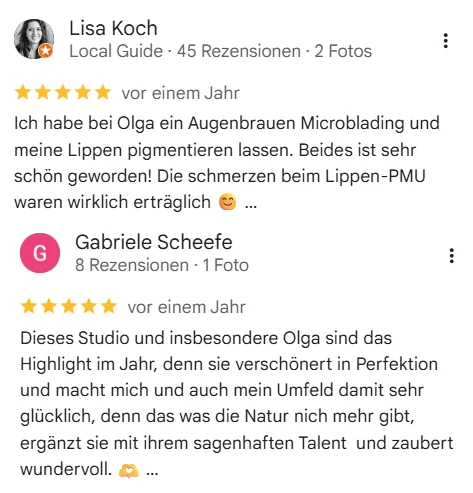









Many regular clients rely on Olga for long-term guidance, while new clients frequently come through personal recommendations. The right appointment may therefore require a little lead time. Plan your personal assessment early: a short wait is a positive sign of trust in an artist for whom even a visit without pigment can deliver a valuable result.