Permanent eyeliner after eye surgery: when is the right time?
“Surgery on 3 April, check-up on 17 April, eyeliner at the end of May?” A tidy calendar can feel reassuring. Medical healing, however, does not move through identical boxes. Two women can have the same eye procedure on the same day and reach very different stages several weeks later.
That is why a responsible answer is not a universal number. Permanent eyeliner should only be considered when the eye area is completely calm, follow-up care is completed or stable, and the operating ophthalmologist has explicitly approved pigmentation. Not merely eye makeup. Permanent makeup.
“Eye surgery” is not yet enough information
Cataract surgery takes place inside the eye. LASIK, PRK and other refractive procedures affect the corneal surface in different ways. With blepharoplasty or ptosis surgery, the incision lies directly on the eyelid, close to the future pigmentation zone. Retinal, glaucoma and tear-duct operations have their own aftercare plans as well.
Olga Keller therefore begins an enquiry with four questions rather than counting weeks: Which procedure was performed? When? How did the follow-up visits go? Which restrictions still apply? “Everything is fine” is welcome news, but it is not precise enough for planning PMU.
The sequence of surgery on both eyes matters too. Someone who has completed cataract surgery on one eye but is waiting for the second is still in the middle of a medical process. There is no benefit in squeezing a cosmetic appointment between operations. Treatment and recovery come first.
Four green lights matter more than a deadline
The first is a quiet eye surface: no increasing redness, swelling, pain, sensitivity to light, sticky discharge or unexplained watering. Worsening vision, flashes, new floaters, severe pain or discharge require contact with the eye clinic, not a cosmetic studio.
The second is stable aftercare. Prescribed antibiotic or anti-inflammatory drops are used exactly as directed. They are never paused for PMU or stopped early without medical advice. Dry eyes after refractive surgery can persist even when vision is already sharp. An eyelid that is frequently rubbed or constantly watering is not yet a suitable working area.
The third is a completed review. “The clinic did not call again” does not mean the same thing as medical clearance. At a follow-up, the surgeon can assess healing that cannot be judged from the outside.
The fourth is an unambiguous yes. Ask: “May permanent makeup be implanted along my upper lash line?” This tells the doctor that the appointment involves repeated touching and stabilising of the lid as well as small controlled openings in the skin.
Permission to wear mascara is not permission for PMU
Aftercare sheets specify different pauses for eye makeup according to the procedure and clinic. That is not a contradiction; operations and individual recovery vary. Being allowed to use mascara or eyeshadow is still only one milestone. Cosmetics sit on the surface and are removed at night. PMU opens the skin, keeps the eyelid stabilised for longer and starts another healing process.
“Makeup allowed” should therefore not become “PMU tomorrow”. Give the eye an additional quiet period and obtain specific approval. A studio can assess whether the outer skin is cosmetically suitable, but it cannot clear the healing of the cornea, lens, retina or internal eye structures.
New eyeliner should not be scheduled immediately before eye surgery either. The eye area needs to be calm and clean for the operation; fresh PMU adds an avoidable healing zone. If surgery has already been booked, it comes first.
After eyelid surgery, closed skin is not a finished scar
After upper blepharoplasty, ptosis correction or another eyelid operation, healing takes place in the exact tissue that would be moved and stretched during pigmentation. A closed surface does not mean scar maturation is complete. Redness, residual swelling, tightness and altered sensation may last much longer than visible bruising.
Extra patience is needed here. The surgeon should confirm that the tissue and scar are stable enough. It can be sensible to think in months rather than weeks. The same caution applies if dryness continues, the eyelid does not close completely or further corrective treatment is planned.
An existing line does not need to be “rescued” during this period. It can fade. A later permanent eyeliner refresh is easier to design once the new lid shape and scar have genuinely settled.

Once healed, the old design deserves a fresh assessment
Eye surgery may change visual perception, while eyelid surgery can also change how much mobile lid is visible. A favourite old wing should not simply be copied. Olga sketches on the eye as it looks today and checks the line with eyes open and closed, sitting upright and using natural facial movement.
A delicate lash-line enhancement is often an elegant way to return. Pigment is placed only between the upper lashes, making their roots look quietly denser. It is still permanent makeup and requires the same medical clearance. “Thinner” means aesthetically more restrained, not medically possible sooner.
If a visible line is preferred, a conservative start is wise. A fine healed result can be reviewed later; an overly wide line cannot simply be taken back on altered eyelid skin. Eye drops, dry-eye symptoms, contact lenses and previous reactions should all be discussed honestly before treatment.
Olga Keller may say no even when the calendar says yes
Olga Keller is a state-trained cosmetician with a medical foundation and has been one of Berlin's Microblading and PMU pioneers since 2013. Almost 13 years of experience and thousands of successful procedures have sharpened her judgement of skin, eyelid anatomy and responsible limits. She personally consults and treats every PMU client.
Olga uses certified German-made pigments free from heavy metals and iron oxides. Her philosophy is naturalness: eyeliner should quietly clarify the gaze, not advertise a cosmetic decision. If medical clearance is missing, the eye remains irritated or the requested shape would not be harmonious, she declines treatment.
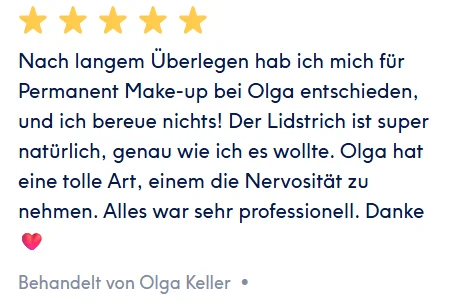
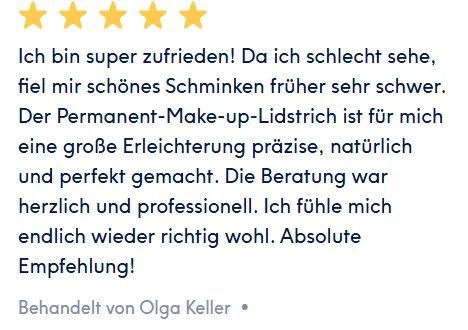
Clients travel to her from across Germany and abroad, and well-known personalities and politicians trust her experience and discretion. Hundreds of five-star reviews on Google, Treatwell, Facebook and other platforms support this careful approach.
After medical clearance, arrange a personal consultation with Olga at Kosmetikinstitut Expert in Berlin and bring your operation or follow-up report if possible. She has many loyal regulars and new clients often arrive through recommendations, so the right appointment may require a little notice. After eye surgery, that is not a disadvantage: it provides valuable extra distance from the recovery period.