Eczema or psoriasis: when is permanent makeup a poor idea?
Skin has a memory, but it does not follow a fixed calendar. It may look calm on Tuesday and still respond to controlled injury very differently from someone else’s skin. That is the difficulty when permanent makeup meets atopic eczema or psoriasis: a reassuring look in the mirror is only a snapshot.
The diagnosis alone does not settle the question. Neither does a symptom-free day automatically make pigmentation appropriate. The precise area, disease activity over recent weeks and months, previous responses to injury, current treatment and a dermatologist’s view all matter. Sometimes the responsible answer is not “never” but “not now”. Sometimes it remains a firm no.
Calm skin means more than an absence of redness
Before PMU, it is not enough to check for an obvious plaque on the brow, eyelid or lip. Dryness, tiny fissures, itching, burning, scaling, thickened skin, weeping or fresh scratch marks all show that the barrier is not stable. Such skin is not treated.
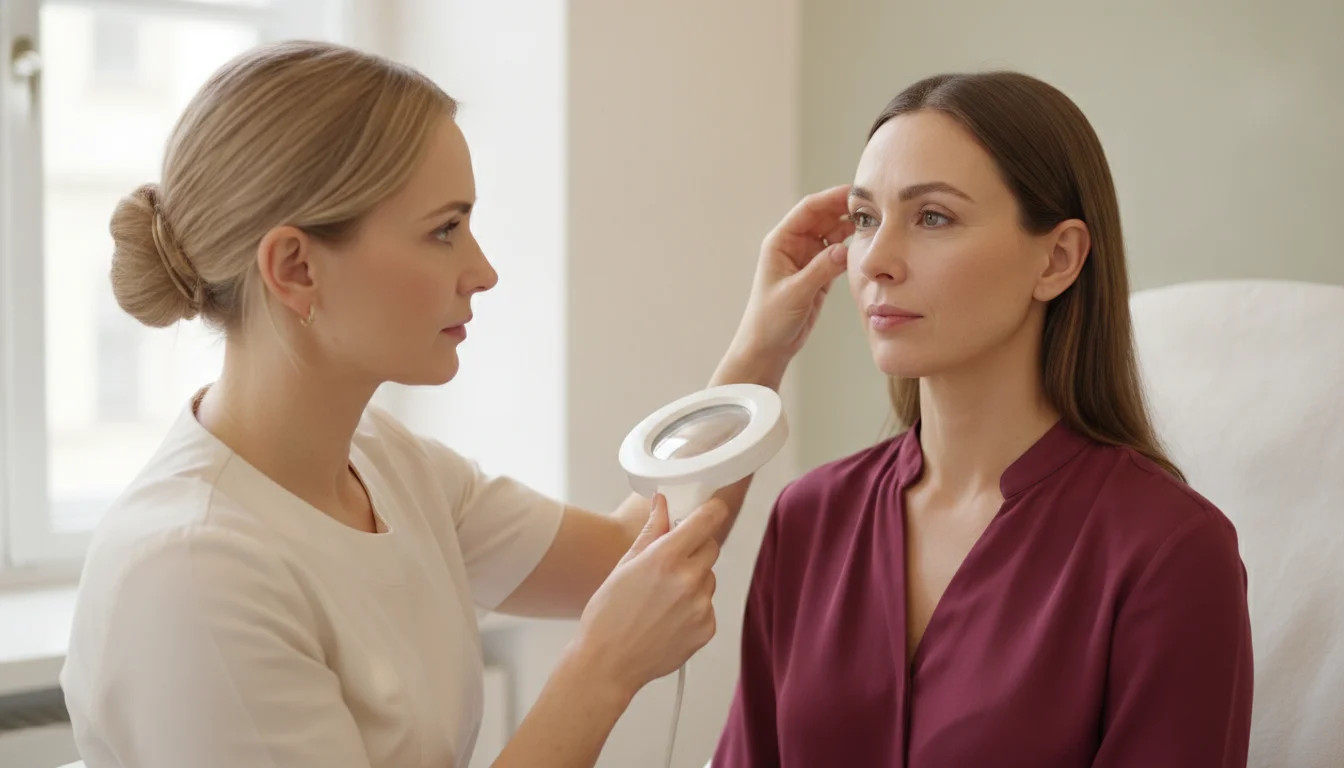
A recently settled area still deserves caution. If it remains sensitive or has only just calmed with a topical steroid, calcineurin inhibitor or another therapy, the studio cannot invent a waiting period. The dermatologist understands the disease and medication; Olga can then assess whether cosmetic work appears technically feasible.
A photograph from a good skin day is not enough. A brief timeline is more useful: when was the last flare, which facial areas were involved, and how did the skin respond to small scratches, waxing, adhesives or previous tattoos? Those details turn “it is usually fine” into a meaningful history.
With psoriasis, injury itself may be the trigger
Psoriasis can develop at a site where skin has been injured. This is known as the Koebner phenomenon. Because PMU creates many fine openings in the skin, the risk cannot be dismissed simply by saying micropigmentation is shallower than a conventional tattoo.
The problem need not be immediate. An area may initially resemble normal healing and develop characteristic changes later. Anyone who has seen psoriasis appear after a scratch, cut, sunburn or tattoo should tell both the dermatology team and Olga.
Dermatology organisations advise people with psoriasis to approach tattoos and other body art cautiously and to speak with a dermatologist first. For PMU, a small treatment area is not an automatic permission slip. A decorative result is not worth provoking an avoidable facial flare.
Atopic eczema raises a different set of questions
With atopic dermatitis, the focus is on an impaired skin barrier, inflammation, itching and susceptibility to infection. Fine injury and components used during pigmentation may irritate the skin; a healing PMU site must not be scratched. If you scratch unconsciously at night, that belongs in the decision.
Words such as “hypoallergenic” or “sensitive” do not resolve the issue. A high-quality pigment does not make actively inflamed skin robust. A patch test may reveal a response to the tested substance, but it cannot guarantee that there will be no later flare, infection or reaction to the whole procedure.
Eczema on the body and planned facial PMU are not automatically unrelated. A widespread or currently active flare suggests that the disease is not settled. Whether a distant, visibly clear area should be treated therefore needs dermatological discussion.
These stop signs are not negotiable
Active plaques or eczema in the treatment area, broken or weeping skin, crusts, signs of infection, fresh cold sores and obvious scratching mean no PMU. The same applies during a severe flare, fever or when a new skin change has not been diagnosed. Pigment must never be used to conceal an inflamed plaque or an uncertain lesion.
Systemic treatment, biologics, immunosuppressants and recent medication changes belong in the medical conversation. Nothing is stopped independently for permanent eyebrow makeup, permanent eyeliner or lip blush. The risk of destabilising a skin condition can outweigh a cosmetic wish.
Even after medical advice, Olga retains the practical decision. If texture, sensitivity or healing conditions are unsuitable on the day, treatment is postponed. Equally, Olga’s visual assessment is not a diagnosis: a new or uncertain mark belongs with a dermatologist first.
A sound plan includes the option of doing nothing
If treatment is considered, the area and technique are chosen conservatively. Combining several zones in one visit is not a clever shortcut for reactive skin. Aftercare must fit with dermatological treatment, and extra creams, antiseptics or home remedies are not added spontaneously. Increasing redness, warmth, pain, swelling, weeping or pustules needs medical assessment.
Olga Keller is a state-trained cosmetician with a medical foundation and has pioneered microblading and PMU in Berlin since 2013. Almost 13 years of experience and thousands of successful treatments have sharpened her eye for both natural results and responsible limits. She personally assesses and treats every PMU client.
Olga uses certified German-made pigments free from heavy metals and iron oxides. Her aim is harmony that looks as though nothing has been done. That standard includes declining pigmentation when the skin or health context does not support a sound result.
Clients travel from across Germany and abroad, and well-known personalities and politicians value her precision and discretion. Hundreds of five-star reviews on Google, Treatwell, Facebook and other platforms reflect that approach. Olga has many returning clients and receives frequent referrals, so a suitable assessment may require some notice. With a chronic skin condition, that is useful time: a good decision deserves more than the first empty slot.